• Form CRS | Client Logins | (830) 609-6986

Christian Financial Advisors®
  • About
      • Our Team
      • What We Believe
          • Our Guiding Principles
          • Our Investment Principles
        • Close Menu
      • How We Are Paid
      • How We Are Different
      • Values Based Investing
      • CIS Wealth?
    • Close Menu
  • Services
      • Fees and Service Tiers
      • Investment Management
      • Financial Planning
      • Retirement Planning
      • Estate Planning
      • Planned Giving
      • Trust Services
    • Close Menu
  • Education
      • All Articles
      • Monthly Bullet Points
      • Monthly Financial Newsletter
      • Podcast
      • What The Bible Says About Finance
    • Close Menu
  • Locations
      • New Braunfels, Texas
      • Land O’ Lakes, Florida
    • Close Menu
  • Client Logins
  • Schedule a Meeting
Schedule a Meeting
Call Meet Menu

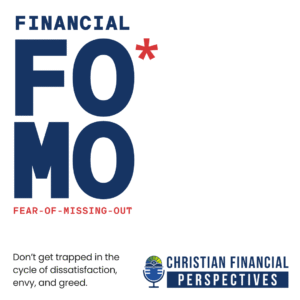
Do you suffer from Financial FOMO [Fear of Missing Out]
Home » Podcast Episodes » Do you suffer from Financial FOMO [Fear of Missing Out]

album-art
07/29/2024
00:00
Sorry, no results.
Please try another keyword
  • 4483
    https://www.christianfinancialpodcast.com/205-financial-fomo/
    Do you suffer from Financial FOMO [Fear of Missing Out]
    205
    Are you constantly chasing the next big investment opportunity? Do you never feel content with your current financial situation? Financial FOMO, or the fear of missing out, can trap us in a cycle of dissatisfaction, envy, and greed. In this episode, Bob and Shawn expose the dangers of the “Financial FOMO” mindset. Unfortunately, companies and media use financial FOMO to manipulate consumers into overspending and taking on debt. The antidote we recommend? Finding contentment in Christ, practicing gratitude, and focusing on reasonable returns rather than chasing the latest trends to help try and live a more fulfilling and financially stable life.
    Shawn: Are you constantly chasing the next big investment opportunity? Never feeling content with your current financial situation, financial, FOMO, or the fear of missing out can trap us in a cycle of dissatisfaction, envy, and greed. In this episode, we’ll expose the dangers of this mindset and uncover biblical truths that lead to true contentment in Christ no matter our circumstances. Let’s get some perspective. Welcome to another episode of Christian Financial Perspectives. We’re so glad that you’ve joined us today as we dive into financial FOMO, and I don’t know if you’ve ever heard of the term FOMO before, it means fear of missing out, but then there is financial FOMO, which we’re going to get into. Bob has graciously put a definition into our outline. Financial FOMO reflects the psychological aspect of investing where individuals are influenced more by emotions and the fear of missing out on market returns than by objective numerical analysis. Bob: Pretty good, huh? Shawn: End program. Bob: I think about, I guess it was just four or five years ago, and you knew when we started the podcast, Mary Jo helped me do it and we had a program way back that we did FOMO, and I was like, what’s FOMO? I didn’t even know what FOMO was, and now it’s become such a popular term and it’s very popular in the social media area as well. So you picked a really good scripture here. I like Shawn. Shawn: We actually have three scriptures for today. Bob: You have three of them today. Okay. Why don’t you read the first one? I’ll read the one in the middle and you catch this last one. Shawn: Sounds good. Well, first we’re going to start with Philippians 4:11-13. All of these are from the NASB if someone wants to read it for themselves, but Philippians 4:11-13, “Not that I speak from need, for I have learned to be content in whatever circumstances I’m in. I know how to get along with little, and I also know how to live in prosperity. In any and every circumstance, I have learned the secret of being filled and going hungry, both of having abundance and suffering need. I can do all things through him who strengthens me.” And this passage really, to start us out, really helps to emphasize the importance of finding contentment in Christ regardless of our financial circumstances. Bob: Boy, that scripture really goes good with the fear of missing out. The next one is Hebrews 13:5, “Make sure that your character is free from the love of money, being content in what you have, for He himself has said, ‘I will never desert you, nor will I ever forsake you.’” Yeah, it’s true. This passage reminds us to really find contentment in what we do have, not what we don’t have, and to trust in God’s provision and presence in our lives. And rather than constantly seeking more and more money, more possessions. Shawn: That’s right. And the most common thing that I hear people say sometimes is, “Money is the root of all evil.” It’s like, well, no, no, that’s a misquote. It’s, “The love of money is the root of all kinds of evil.” Not all evil, but all kinds of evil. And so we see, and I have one more scripture please, Ecclesiastes 5:10 that also again says loves money or love of money, “He who loves money will not be satisfied with money, nor he who loves abundance with its income. This too is vanity.” This verse highlights the futility of constantly pursuing wealth and abundance as it will never bring true satisfaction or contentment. So there’s nothing wrong with money and wealth in and of itself, right? Bob: Yeah. Shawn: The problem comes in your heart. If you are seeking money for the sake of money, if you are seeking money for the sake of more possessions or things, even if you get it, you’re still not going to be happy. That’s the issue. Bob: It’s always going to be a little bit more in it. Yeah. When I was thinking about FOMO and financial FOMO, Shawn: Or F-FOMO, Bob: I mean I know it’s like FOMO, what does that FOMO mean again – fear of missing out. And I came up with lots of examples as I was thinking about this. I actually came up with 10 of them. The first example I see being that we’re in the financial advisory business, I see the fear of missing returns. Shawn: So chasing returns. Bob: Chasing returns, chasing returns is one of the examples of financial FOMO and always trying to buy those stocks or ETFs that everyone else seems to be buying. And it’s usually after, not before, they’ve appreciated beyond reason for the fear of missing out. It’s like, “I’ve missed, now I’ve missed this. I better go get in because it’s going to continue to go.” And boy, the media just plays into that. Shawn: By the time you heard about it, it’s probably already appreciated about as much as it will, and that’s just the way it works. So number two, switching advisory firms, changing advisory firms every few years due to fear of missing out. Bob: As I was thinking about this, switching advisory firms too, and I had an example, was occasionally, and by the way, it happens about every three or four years you have this timeframe. I don’t know where it’s the stars are aligned right or barometric pressure or what. You’ll have 1-2% of your client base that will start saying, “Well, I need to go find another advisor.” And other advisors are experiencing the same thing, because we’ll gain clients from an advisor that we’ll lose other clients to. And it’s like no one’s gaining anything. Shawn: There’s been a couple times, Bob, I remember we had a client leave for an advisor and there was a client that came to us that actually came from the same advisor. Bob: No, no. That’s what I’m saying. Shawn: They just swapped. Bob: Yeah, you swapped. No, that’s not just a couple of times. That’s happened many times. Shawn: Well, you’ve been around longer than me. I was saying specifically I remember it happening. Bob: My small town. Well, I say that. It’s not the small town of New Braunfels anymore. It used to be. But that happens and it’s interesting. It’s like that grass is better over there. Shawn: On that. It’s not that you can never switch advisory firms, right? Bob: Of course not. Shawn: What we’re talking about more is the every three to four years something, but we understand that maybe you were with a firm when you were younger, and as you’re maybe getting in your forties or fifties and you’re looking more towards retirement, if you feel like the firm you were with is not capable of helping with that, then okay, maybe you look for another one. We get it, but you’re better off not changing too often. Bob: That’s right. Shawn: So anyway, that’s kind of the point on that one. Number three, comparing your situation to others. Bob: Oh boy, that’s big FOMO, isn’t it? Shawn: A little bit, yeah. No matter how in tune we are with the Lord that is, I feel like, always a struggle. Bob: There’s always not… Shawn: … Bob: There’s always going to be somebody that has more, unless you’re Elon Musk or Warren Buffet, or… Shawn: Unless you’re on the top of the list. Bob: And you’re that top 5 in the world. I mean, there’s always going to be that you’re trying to compare, and you need to just stop it. Stop that. I mean, that is such an example of FOMO and fear of missing out. Shawn: And when you constantly do that, it leads to dissatisfaction and envy. Bob: Which takes us to the next point. Comparing also causes coveting, right? Shawn: So number four, coveting what others have or seem to be getting. Bob: And that’s the last of the 10 commandments. You’re not supposed to covet what others have, and that’s really desiring those possessions and lifestyle or financial success of others, and that can lead to resentment and inadequacy. Shawn: And you also don’t know, again, when it seems like someone is getting all this, well, what you don’t know in most cases, are they getting these things by putting it on the credit card that they’re not going to pay off in full before the statement, before the due date. Are they borrowing money from an equity loan or line of credit from their house? You don’t know. But even if they are not having to borrow money for it, you still shouldn’t focus on it. Focus on what the Lord has entrusted you with and manage it well. Bob: When I was talking to Rachael about this morning, she was mentioning that that FOMO gets people in high debt. Shawn: Yeah. Which goes right to number five, which is financial FOMO can result in becoming greedy. You end up having this constant pursuit of more wealth and possessions, and it leads to a greedy and selfish mindset where you prioritize the material gain over other important aspects of life, like your relationship with the Lord, your family. I mean, what kid would ever say as an adult, “Oh, I wish my dad or I wish my mom had spent more time in the office to buy us stuff instead of all the quality time that we got to have together.” Bob: Yeah. Well, like I mentioned a few podcasts back, you’ve never met a person on their deathbed that says, “I wish I had have spent more time making making money,” but they wish they’d spent more time. You can’t replace time with your family. And I think, see, this leads right into that next one. Shawn: You did really good on this one, Bob. Bob: Thank you. Shawn: Leads right into the next one. Bob: Well, number six, not exactly in this order, but I redid the order this morning before we made this. So, it leads into hurting relationships. Shawn: Financial FOMO hurts relationships, Bob: It strains them, it constrains them with friends and family and loved ones, because you’re constantly focusing on what others have and focusing on what you don’t have. Shawn: Instead of the people in your life. So number seven, financial FOMO results in a need for more and more control. Bob: I’ve seen this, Shawn, I’ve really seen this. Some people, they just need that control of everything and you need to let go and let God. And it’s that fear of missing out can lead to a desire to control every aspect of your financial life really causing a lot of stress and anxiety. Shawn: Yeah. It’s the same reason why we always encourage our clients and would encourage anyone watching or listening, if you do have investments and you have a professional financial manager that’s managing that for you, do not look at it every day. I would say, at most, look at it once a month because you are dealing with a year’s timeline, not a next few months, not this quarter. And so, fluctuations are normal. Don’t focus on having to control and worry about that all the time because it’s just going to cause you stress and anxiety that you don’t need. Bob: So I want to go into this number eight. This is an old saying. Many of us have heard our whole life, especially if you have ever been around ranching, because cows have a real tendency to do this. Financial FOMO tricks you into thinking that the grass is always greener somewhere else. I’ve seen cows get out of the pasture as. I did work on a ranch in my younger years and my grandfather was a big rancher, and they get outside the fence and they’re kind of like, I kind of want back in because they get mixed up when they get out and they don’t know where they are. But that mode of thinking will really cost you. Shawn: Yeah. Well, and that goes very much against what scripture tells us in that wealth gained quickly is quickly lost, but gained little by little lasts. I know I’m paraphrasing a little bit, but that’s the point, is that true wealth, financial wealth, I don’t mean true wealth like spiritual, but building wealth in this life, it comes down to little by little. There’s not some magic bullet or something else that’ll just, “Oh, you do this one trick, and financial advisors hate this one trick.” No, it’s little by little. I mean, how many clients have we dealt with over the years? And especially you, because you’ve been doing this longer than me, where you’re some of your wealthiest never made that much money as a household during their career, but they’re multimillionaires because they lived within their means. They saved and invested consistently. They didn’t constantly look for something somewhere else, and they stuck to the plan. So then when they retired, they were prepared. Bob: Which goes into number nine. They don’t have a jumper mentality. They don’t jump around. They don’t think the grass is greener and they don’t start jumping around like a rabbit trying to figure out where they are. They stick to it. Shawn: So financial FOMO causes a jumper mentality. Bob: Yes. Shawn: Which we don’t want. Bob: Yeah, exactly. Shawn: Then number 10. Bob: Number 10, yeah. Shawn: Financial FOMO can rob you of contentment and happiness. Bob: Oh, big time. Big time. It can lead to a constant state of dissatisfaction with what you have and unhappiness. You’re always seeking the next best thing. So as I was doing this, I said, okay, these are these 10 ways. I said, how is it used today? Because what’s kind of sad in all this is that companies and people use FOMO to their advantage, their financial FOMO… Shawn: To get people to do what they want from a financial perspective. Bob: So you go into that first one. Shawn: So number one, commission-based advisors, they use financial FOMO to sell high commission financial products like gold and annuities. Bob: They convince you if you don’t do this, you’re missing out, and they try to make you think you’re not very smart. Shawn: And you know what Bob? They are right. If you don’t do this, you’re missing out on a bad investment. Bob: Yeah. That’s true. The second one is the media. The media is constant. They’re using financial FOMO through advertising to entice consumers to spend money on products and services that they really don’t need, “But if you don’t have this, then you’re not going to get this.” Shawn: According to a certain car manufacturer around Christmas time, you’re supposed to buy your spouse a new car with a big red bow on it. Bob: Yeah. I’ve seen that. Shawn: Wait, we’re not going to mention it cause I don’t want them to get mad at us. Number three, entertainment. Programs like HGTV can make you feel like you’re missing out on the perfect home or renovation. Bob: I’m always saying, whatever color it is today, it’s going to change in two years. If you go spend all money because you feel like, “I’m missing out. My home needs to look this way because all the homes on HGTV look this way.” As soon as you get it all paid for, it’s going to change in two years, so just wait long enough, it’ll come back. Whatever you have right now, the colors probably would just come back. Shawn: Yeah. I mean, if the paint’s peeling or something, sure, you can reduce the maintenance, but you don’t have to change the color everywhere. Bob: Yeah. But I’ve seen so much of that. I mean, you’ve got a perfectly good granite countertop. Well now if it’s a certain color in granite, you’ve got to go get another color in granite or you got to get the stone. You’ve got to get something different, and that’s entertainment and they try to convince you of that. And I think HGTV, many times, is sponsored by all the vendors that sell the stuff. Shawn: That’s weird. Yeah. You see this thing about all these paint changes and the new countertops, and then they’re sponsored by “fill-in-the-blank paint company” and this stone or masonry group that that’s…Oh weird, right? So number four. Bob: Oh, this is a big one. I see the number one financial website, it’s probably CNBC, and then there’s Yahoo Finance and Google Finance. But these channels really use financial FOMO a lot to keep their viewers engaged and constantly seeking the next big investment opportunity. And they make you feel like a fool because they’ll say, “Such and such, this week was up this much or this month was up this much,” and they make you feel like, “Well, I’ve just missed out. I better go get into that before I miss out anymore.” Shawn: I don’t want to miss out on the next week. Bob: It kind of goes back to what we were talking about at the very, very beginning, but companies do this and of course number five is the big one. That was the one that my wife gave me the idea of this morning. Just the credit card companies and lenders. Shawn: Right. They use financial FOMO to make you their slave by encouraging overspending and taking on debt. They often promote a lifestyle that is beyond your means, leading to a cycle of debt and financial stress. I mean, the most common thing I’ve seen with credit cards is if you’ve been doing good with actually paying things off and you’ve got a good credit score, “Oh, well, would you like to increase your limit? You’ve actually been approved to increase your limit.” Well, if you’re spending what you need to spend and you’re making sure to stick with your budget, why would you need a higher limit? That doesn’t make any sense. Bob: It’s interesting, Shawn. Shawn: You’re just asking to get sucked in and spend more than you should be spending. Bob: A good credit score is good. I mean, I want you to have a good credit score, but really if you’re debt free, you don’t need a credit score. Shawn: Yeah, exactly Bob: Matter of fact, if you’re totally debt free, your credit score goes down. I don’t know if you knew that or not, even though you have tremendous amount in cash reserves and savings and investments. I mean, you could have $5 million or $10 million and be totally debt free and your credit score may be 200 because you hadn’t borrowed anything, but you’re a lot better off than most people. Okay, so I thought about there’s got to be an antidote to this financial FOMO. And I’ve thought of three different areas. Go ahead and share number one. Shawn: Sure. Number one is find contentment in Christ, not in the size of your portfolio, the latest returns, or what others seem to be making or have. Remember that true joy and peace comes from a relationship with God, not material possessions or financial success. Bob: You said it well, you wrote it down well, too. Shawn: I did. Yeah, it does help. Don’t tell anybody we have a computer in front of us to help with. Bob: Oh, I they know it. The second one is I want you to find contentment in the things that you do have, not in what you don’t have. Practice gratitude. Even say every day, “Lord, thank you for those things that I do have.” And focus on the blessings in your life rather than constantly seeking more. Get rid of that FOMO, that fear of missing out. Shawn: Number three, find contentment in reasonable returns not in what the financial media is trying to convince you that you’ve somehow missed out on. Bob: Can you see that a financial advisor wrote that? Yeah, I wrote that and I’ll say right now that reasonable returns are what we aim for around here. I’m not trying to hit home runs and get strikeouts. I’m trying to hit base hits. Shawn: If you’re looking at investment management purely from a performance standpoint, it’s very easy to get sucked into, “What is the return? I need to get the return higher.” But if you set realistic financial goals and you stick to a well thought out investment strategy rather than chasing the latest trends or hot investments, you’ll do well in the long run. I think a great example is if your average return is say 5-6% and you’re looking at your financial planning and for when you retire and then in retirement, okay, I’m hitting all the numbers for income that we’re going to need based on the plan. Great. Well, okay, maybe somewhere else there’s a 7% or 8% or a 10%, but does it really matter? If you’ve set out the goal and this is what you’re trying to do or if you have that goal of this is what I want to do in retirement, the Lord’s calling me to, it doesn’t really matter if you might be able to have a better return somewhere else if you’re on track for those goals that you’ve set. Bob: You said it perfectly and you’re going to have to take more risks to get those higher returns, too. Shawn: Yeah, exactly. Bob: I mean you have to. Risk and reward go hand in hand. Shawn: So in conclusion. Bob: In conclusion, yeah. Shawn: If we commonly accept the will of God for each one of us and accept changes in life, we’ll not be bothered by the severe or the constant obsessive fear of the financial fear of missing out. Bob: Amen. Let’s find our contentment in Christ and nothing else and focus on the blessings that are in our lives and overcome the negative effects of financial FOMO and live a more fulfilling, financial, stable life. I think that says it perfect. Shawn: Thanks as always for joining us. God bless. If you have any comments or topics or anything else you want to share, we’d love to hear from you. Comment, send us a message on our website, www.ChristianFinancialAdvisors.com or call or text us at (830) 609-6986. Until next time, thank you and God bless. [CONCLUSION] That’s all for now. We invite you to listen to all of our past episodes covering many financial topics from a Christian Perspective. To make sure you don’t miss any of Bob’s upcoming episodes you can subscribe to Christian Financial Perspectives on iTunes, Google Play Music, Spotify, or Stitcher. To learn more about integrating your faith with your finances, visit ciswealth.com or call 830-609-6986. [DISCLOSURES] * Investment advisory services offered through Christian Investment Advisors Inc dba Christian Financial Advisors®, a registered investment advisor registered with the SEC. Registration as an investment advisor does not imply a certain level of skill or training. Comments from today’s show are for informational purposes only and not to be considered investment advice or recommendations to buy or sell any company that may have been mentioned or discussed. The opinions expressed are solely those of the hosts, Bob Barber and Shawn Peters, and their guests. Bob and Shawn do not provide tax advice and encourage you to seek guidance from a tax professional. While Christian Financial Advisors® believes the information to be accurate and reliable, we do not claim or have responsibility for its completeness, accuracy, or reliability.
    https://christianfinancialadvisors.com/wp-content/uploads/205-TRANSCRIPT.en_US.txt
    https://christianfinancialadvisors.com/podcast/205-financial-fomo/
    https://christianfinancialadvisors.com/podcasts/episodes/205-financial-fomo/
    991658037

Do you suffer from Financial FOMO [Fear of Missing Out]

Are you constantly chasing the next big investment opportunity? Do you never feel content with your current financial situation? Financial FOMO, or the fear of missing out, can trap us in a cycle of dissatisfaction, envy, and greed. In this episode, Bob and Shawn expose the dangers of the “Financial FOMO” mindset.

Unfortunately, companies and media use financial FOMO to manipulate consumers into overspending and taking on debt. The antidote we recommend? Finding contentment in Christ, practicing gratitude, and focusing on reasonable returns rather than chasing the latest trends to help try and live a more fulfilling and financially stable life.


Episode Transcript

Shawn:
Are you constantly chasing the next big investment opportunity? Never feeling content with your current financial situation, financial, FOMO, or the fear of missing out can trap us in a cycle of dissatisfaction, envy, and greed. In this episode, we’ll expose the dangers of this mindset and uncover biblical truths that lead to true contentment in Christ no matter our circumstances. Let’s get some perspective. Welcome to another episode of Christian Financial Perspectives. We’re so glad that you’ve joined us today as we dive into financial FOMO, and I don’t know if you’ve ever heard of the term FOMO before, it means fear of missing out, but then there is financial FOMO, which we’re going to get into. Bob has graciously put a definition into our outline. Financial FOMO reflects the psychological aspect of investing where individuals are influenced more by emotions and the fear of missing out on market returns than by objective numerical analysis.

Bob:
Pretty good, huh?

Shawn:
End program.

Bob:
I think about, I guess it was just four or five years ago, and you knew when we started the podcast, Mary Jo helped me do it and we had a program way back that we did FOMO, and I was like, what’s FOMO? I didn’t even know what FOMO was, and now it’s become such a popular term and it’s very popular in the social media area as well. So you picked a really good scripture here. I like Shawn.

Shawn:
We actually have three scriptures for today.

Bob:
You have three of them today. Okay. Why don’t you read the first one? I’ll read the one in the middle and you catch this last one.

Shawn:
Sounds good. Well, first we’re going to start with Philippians 4:11-13. All of these are from the NASB if someone wants to read it for themselves, but Philippians 4:11-13, “Not that I speak from need, for I have learned to be content in whatever circumstances I’m in. I know how to get along with little, and I also know how to live in prosperity. In any and every circumstance, I have learned the secret of being filled and going hungry, both of having abundance and suffering need. I can do all things through him who strengthens me.” And this passage really, to start us out, really helps to emphasize the importance of finding contentment in Christ regardless of our financial circumstances.

Bob:
Boy, that scripture really goes good with the fear of missing out. The next one is Hebrews 13:5, “Make sure that your character is free from the love of money, being content in what you have, for He himself has said, ‘I will never desert you, nor will I ever forsake you.’” Yeah, it’s true. This passage reminds us to really find contentment in what we do have, not what we don’t have, and to trust in God’s provision and presence in our lives. And rather than constantly seeking more and more money, more possessions.

Shawn:
That’s right. And the most common thing that I hear people say sometimes is, “Money is the root of all evil.” It’s like, well, no, no, that’s a misquote. It’s, “The love of money is the root of all kinds of evil.” Not all evil, but all kinds of evil. And so we see, and I have one more scripture please, Ecclesiastes 5:10 that also again says loves money or love of money, “He who loves money will not be satisfied with money, nor he who loves abundance with its income. This too is vanity.” This verse highlights the futility of constantly pursuing wealth and abundance as it will never bring true satisfaction or contentment. So there’s nothing wrong with money and wealth in and of itself, right?

Bob:
Yeah.

Shawn:
The problem comes in your heart. If you are seeking money for the sake of money, if you are seeking money for the sake of more possessions or things, even if you get it, you’re still not going to be happy. That’s the issue.

Bob:
It’s always going to be a little bit more in it. Yeah. When I was thinking about FOMO and financial FOMO,

Shawn:
Or F-FOMO,

Bob:
I mean I know it’s like FOMO, what does that FOMO mean again – fear of missing out. And I came up with lots of examples as I was thinking about this. I actually came up with 10 of them. The first example I see being that we’re in the financial advisory business, I see the fear of missing returns.

Shawn:
So chasing returns.

Bob:
Chasing returns, chasing returns is one of the examples of financial FOMO and always trying to buy those stocks or ETFs that everyone else seems to be buying. And it’s usually after, not before, they’ve appreciated beyond reason for the fear of missing out. It’s like, “I’ve missed, now I’ve missed this. I better go get in because it’s going to continue to go.” And boy, the media just plays into that.

Shawn:
By the time you heard about it, it’s probably already appreciated about as much as it will, and that’s just the way it works. So number two, switching advisory firms, changing advisory firms every few years due to fear of missing out.

Bob:
As I was thinking about this, switching advisory firms too, and I had an example, was occasionally, and by the way, it happens about every three or four years you have this timeframe. I don’t know where it’s the stars are aligned right or barometric pressure or what. You’ll have 1-2% of your client base that will start saying, “Well, I need to go find another advisor.” And other advisors are experiencing the same thing, because we’ll gain clients from an advisor that we’ll lose other clients to. And it’s like no one’s gaining anything.

Shawn:
There’s been a couple times, Bob, I remember we had a client leave for an advisor and there was a client that came to us that actually came from the same advisor.

Bob:
No, no. That’s what I’m saying.

Shawn:
They just swapped.

Bob:
Yeah, you swapped. No, that’s not just a couple of times. That’s happened many times.

Shawn:
Well, you’ve been around longer than me. I was saying specifically I remember it happening.

Bob:
My small town. Well, I say that. It’s not the small town of New Braunfels anymore. It used to be. But that happens and it’s interesting. It’s like that grass is better over there.

Shawn:
On that. It’s not that you can never switch advisory firms, right?

Bob:
Of course not.

Shawn:
What we’re talking about more is the every three to four years something, but we understand that maybe you were with a firm when you were younger, and as you’re maybe getting in your forties or fifties and you’re looking more towards retirement, if you feel like the firm you were with is not capable of helping with that, then okay, maybe you look for another one. We get it, but you’re better off not changing too often.

Bob:
That’s right.

Shawn:
So anyway, that’s kind of the point on that one. Number three, comparing your situation to others.

Bob:
Oh boy, that’s big FOMO, isn’t it?

Shawn:
A little bit, yeah. No matter how in tune we are with the Lord that is, I feel like, always a struggle.

Bob:
There’s always not…

Shawn:
…

Bob:
There’s always going to be somebody that has more, unless you’re Elon Musk or Warren Buffet, or…

Shawn:
Unless you’re on the top of the list.

Bob:
And you’re that top 5 in the world. I mean, there’s always going to be that you’re trying to compare, and you need to just stop it. Stop that. I mean, that is such an example of FOMO and fear of missing out.

Shawn:
And when you constantly do that, it leads to dissatisfaction and envy.

Bob:
Which takes us to the next point. Comparing also causes coveting, right?

Shawn:
So number four, coveting what others have or seem to be getting.

Bob:
And that’s the last of the 10 commandments. You’re not supposed to covet what others have, and that’s really desiring those possessions and lifestyle or financial success of others, and that can lead to resentment and inadequacy.

Shawn:
And you also don’t know, again, when it seems like someone is getting all this, well, what you don’t know in most cases, are they getting these things by putting it on the credit card that they’re not going to pay off in full before the statement, before the due date. Are they borrowing money from an equity loan or line of credit from their house? You don’t know. But even if they are not having to borrow money for it, you still shouldn’t focus on it. Focus on what the Lord has entrusted you with and manage it well.

Bob:
When I was talking to Rachael about this morning, she was mentioning that that FOMO gets people in high debt.

Shawn:
Yeah. Which goes right to number five, which is financial FOMO can result in becoming greedy. You end up having this constant pursuit of more wealth and possessions, and it leads to a greedy and selfish mindset where you prioritize the material gain over other important aspects of life, like your relationship with the Lord, your family. I mean, what kid would ever say as an adult, “Oh, I wish my dad or I wish my mom had spent more time in the office to buy us stuff instead of all the quality time that we got to have together.”

Bob:
Yeah. Well, like I mentioned a few podcasts back, you’ve never met a person on their deathbed that says, “I wish I had have spent more time making making money,” but they wish they’d spent more time. You can’t replace time with your family. And I think, see, this leads right into that next one.

Shawn:
You did really good on this one, Bob.

Bob:
Thank you.

Shawn:
Leads right into the next one.

Bob:
Well, number six, not exactly in this order, but I redid the order this morning before we made this. So, it leads into hurting relationships.

Shawn:
Financial FOMO hurts relationships,

Bob:
It strains them, it constrains them with friends and family and loved ones, because you’re constantly focusing on what others have and focusing on what you don’t have.

Shawn:
Instead of the people in your life. So number seven, financial FOMO results in a need for more and more control.

Bob:
I’ve seen this, Shawn, I’ve really seen this. Some people, they just need that control of everything and you need to let go and let God. And it’s that fear of missing out can lead to a desire to control every aspect of your financial life really causing a lot of stress and anxiety.

Shawn:
Yeah. It’s the same reason why we always encourage our clients and would encourage anyone watching or listening, if you do have investments and you have a professional financial manager that’s managing that for you, do not look at it every day. I would say, at most, look at it once a month because you are dealing with a year’s timeline, not a next few months, not this quarter. And so, fluctuations are normal. Don’t focus on having to control and worry about that all the time because it’s just going to cause you stress and anxiety that you don’t need.

Bob:
So I want to go into this number eight. This is an old saying. Many of us have heard our whole life, especially if you have ever been around ranching, because cows have a real tendency to do this. Financial FOMO tricks you into thinking that the grass is always greener somewhere else. I’ve seen cows get out of the pasture as. I did work on a ranch in my younger years and my grandfather was a big rancher, and they get outside the fence and they’re kind of like, I kind of want back in because they get mixed up when they get out and they don’t know where they are. But that mode of thinking will really cost you.

Shawn:
Yeah. Well, and that goes very much against what scripture tells us in that wealth gained quickly is quickly lost, but gained little by little lasts. I know I’m paraphrasing a little bit, but that’s the point, is that true wealth, financial wealth, I don’t mean true wealth like spiritual, but building wealth in this life, it comes down to little by little. There’s not some magic bullet or something else that’ll just, “Oh, you do this one trick, and financial advisors hate this one trick.” No, it’s little by little. I mean, how many clients have we dealt with over the years? And especially you, because you’ve been doing this longer than me, where you’re some of your wealthiest never made that much money as a household during their career, but they’re multimillionaires because they lived within their means. They saved and invested consistently. They didn’t constantly look for something somewhere else, and they stuck to the plan. So then when they retired, they were prepared.

Bob:
Which goes into number nine. They don’t have a jumper mentality. They don’t jump around. They don’t think the grass is greener and they don’t start jumping around like a rabbit trying to figure out where they are. They stick to it.

Shawn:
So financial FOMO causes a jumper mentality.

Bob:
Yes.

Shawn:
Which we don’t want.

Bob:
Yeah, exactly.

Shawn:
Then number 10.

Bob:
Number 10, yeah.

Shawn:
Financial FOMO can rob you of contentment and happiness.

Bob:
Oh, big time. Big time. It can lead to a constant state of dissatisfaction with what you have and unhappiness. You’re always seeking the next best thing. So as I was doing this, I said, okay, these are these 10 ways. I said, how is it used today? Because what’s kind of sad in all this is that companies and people use FOMO to their advantage, their financial FOMO…

Shawn:
To get people to do what they want from a financial perspective.

Bob:
So you go into that first one.

Shawn:
So number one, commission-based advisors, they use financial FOMO to sell high commission financial products like gold and annuities.

Bob:
They convince you if you don’t do this, you’re missing out, and they try to make you think you’re not very smart.

Shawn:
And you know what Bob? They are right. If you don’t do this, you’re missing out on a bad investment.

Bob:
Yeah. That’s true. The second one is the media. The media is constant. They’re using financial FOMO through advertising to entice consumers to spend money on products and services that they really don’t need, “But if you don’t have this, then you’re not going to get this.”

Shawn:
According to a certain car manufacturer around Christmas time, you’re supposed to buy your spouse a new car with a big red bow on it.

Bob:
Yeah. I’ve seen that.

Shawn:
Wait, we’re not going to mention it cause I don’t want them to get mad at us. Number three, entertainment. Programs like HGTV can make you feel like you’re missing out on the perfect home or renovation.

Bob:
I’m always saying, whatever color it is today, it’s going to change in two years. If you go spend all money because you feel like, “I’m missing out. My home needs to look this way because all the homes on HGTV look this way.” As soon as you get it all paid for, it’s going to change in two years, so just wait long enough, it’ll come back. Whatever you have right now, the colors probably would just come back.

Shawn:
Yeah. I mean, if the paint’s peeling or something, sure, you can reduce the maintenance, but you don’t have to change the color everywhere.

Bob:
Yeah. But I’ve seen so much of that. I mean, you’ve got a perfectly good granite countertop. Well now if it’s a certain color in granite, you’ve got to go get another color in granite or you got to get the stone. You’ve got to get something different, and that’s entertainment and they try to convince you of that. And I think HGTV, many times, is sponsored by all the vendors that sell the stuff.

Shawn:
That’s weird. Yeah. You see this thing about all these paint changes and the new countertops, and then they’re sponsored by “fill-in-the-blank paint company” and this stone or masonry group that that’s…Oh weird, right? So number four.

Bob:
Oh, this is a big one. I see the number one financial website, it’s probably CNBC, and then there’s Yahoo Finance and Google Finance. But these channels really use financial FOMO a lot to keep their viewers engaged and constantly seeking the next big investment opportunity. And they make you feel like a fool because they’ll say, “Such and such, this week was up this much or this month was up this much,” and they make you feel like, “Well, I’ve just missed out. I better go get into that before I miss out anymore.”

Shawn:
I don’t want to miss out on the next week.

Bob:
It kind of goes back to what we were talking about at the very, very beginning, but companies do this and of course number five is the big one. That was the one that my wife gave me the idea of this morning. Just the credit card companies and lenders.

Shawn:
Right. They use financial FOMO to make you their slave by encouraging overspending and taking on debt. They often promote a lifestyle that is beyond your means, leading to a cycle of debt and financial stress. I mean, the most common thing I’ve seen with credit cards is if you’ve been doing good with actually paying things off and you’ve got a good credit score, “Oh, well, would you like to increase your limit? You’ve actually been approved to increase your limit.” Well, if you’re spending what you need to spend and you’re making sure to stick with your budget, why would you need a higher limit? That doesn’t make any sense.

Bob:
It’s interesting, Shawn.

Shawn:
You’re just asking to get sucked in and spend more than you should be spending.

Bob:
A good credit score is good. I mean, I want you to have a good credit score, but really if you’re debt free, you don’t need a credit score.

Shawn:
Yeah, exactly

Bob:
Matter of fact, if you’re totally debt free, your credit score goes down. I don’t know if you knew that or not, even though you have tremendous amount in cash reserves and savings and investments. I mean, you could have $5 million or $10 million and be totally debt free and your credit score may be 200 because you hadn’t borrowed anything, but you’re a lot better off than most people. Okay, so I thought about there’s got to be an antidote to this financial FOMO. And I’ve thought of three different areas. Go ahead and share number one.

Shawn:
Sure. Number one is find contentment in Christ, not in the size of your portfolio, the latest returns, or what others seem to be making or have. Remember that true joy and peace comes from a relationship with God, not material possessions or financial success.

Bob:
You said it well, you wrote it down well, too.

Shawn:
I did. Yeah, it does help. Don’t tell anybody we have a computer in front of us to help with.

Bob:
Oh, I they know it. The second one is I want you to find contentment in the things that you do have, not in what you don’t have. Practice gratitude. Even say every day, “Lord, thank you for those things that I do have.” And focus on the blessings in your life rather than constantly seeking more. Get rid of that FOMO, that fear of missing out.

Shawn:
Number three, find contentment in reasonable returns not in what the financial media is trying to convince you that you’ve somehow missed out on.

Bob:
Can you see that a financial advisor wrote that? Yeah, I wrote that and I’ll say right now that reasonable returns are what we aim for around here. I’m not trying to hit home runs and get strikeouts. I’m trying to hit base hits.

Shawn:
If you’re looking at investment management purely from a performance standpoint, it’s very easy to get sucked into, “What is the return? I need to get the return higher.” But if you set realistic financial goals and you stick to a well thought out investment strategy rather than chasing the latest trends or hot investments, you’ll do well in the long run. I think a great example is if your average return is say 5-6% and you’re looking at your financial planning and for when you retire and then in retirement, okay, I’m hitting all the numbers for income that we’re going to need based on the plan. Great. Well, okay, maybe somewhere else there’s a 7% or 8% or a 10%, but does it really matter? If you’ve set out the goal and this is what you’re trying to do or if you have that goal of this is what I want to do in retirement, the Lord’s calling me to, it doesn’t really matter if you might be able to have a better return somewhere else if you’re on track for those goals that you’ve set.

Bob:
You said it perfectly and you’re going to have to take more risks to get those higher returns, too.

Shawn:
Yeah, exactly.

Bob:
I mean you have to. Risk and reward go hand in hand.

Shawn:
So in conclusion.

Bob:
In conclusion, yeah.

Shawn:
If we commonly accept the will of God for each one of us and accept changes in life, we’ll not be bothered by the severe or the constant obsessive fear of the financial fear of missing out.

Bob:
Amen. Let’s find our contentment in Christ and nothing else and focus on the blessings that are in our lives and overcome the negative effects of financial FOMO and live a more fulfilling, financial, stable life. I think that says it perfect.

Shawn:
Thanks as always for joining us. God bless. If you have any comments or topics or anything else you want to share, we’d love to hear from you. Comment, send us a message on our website, www.ChristianFinancialAdvisors.com or call or text us at (830) 609-6986. Until next time, thank you and God bless.

[CONCLUSION]

That’s all for now.

We invite you to listen to all of our past episodes covering many financial topics from a Christian Perspective. To make sure you don’t miss any of Bob’s upcoming episodes you can subscribe to Christian Financial Perspectives on iTunes, Google Play Music, Spotify, or Stitcher. To learn more about integrating your faith with your finances, visit ciswealth.com or call 830-609-6986.

[DISCLOSURES]

* Investment advisory services offered through Christian Investment Advisors Inc dba Christian Financial Advisors®, a registered investment advisor registered with the SEC. Registration as an investment advisor does not imply a certain level of skill or training. Comments from today’s show are for informational purposes only and not to be considered investment advice or recommendations to buy or sell any company that may have been mentioned or discussed. The opinions expressed are solely those of the hosts, Bob Barber and Shawn Peters, and their guests. Bob and Shawn do not provide tax advice and encourage you to seek guidance from a tax professional. While Christian Financial Advisors® believes the information to be accurate and reliable, we do not claim or have responsibility for its completeness, accuracy, or reliability.

[DISCLOSURES]

Investment advisory services offered through Christian Investment Advisors Inc dba Christian Financial Advisors®, a registered investment advisor registered with the SEC. Registration as an investment advisor does not imply a certain level of skill or training. Comments from today’s show are for informational purposes only and not to be considered investment advice or recommendations to buy or sell any company that may have been mentioned or discussed. The opinions expressed are solely those of the hosts, Bob Barber and Shawn Peters, and their guests. Bob and Shawn do not provide tax advice and encourage you to seek guidance from a tax professional. While Christian Financial Advisors® believes the information to be accurate and reliable, we do not claim or have responsibility for its completeness, accuracy, or reliability.

Recent Episodes

  • A Biblical Worldview of Tithing and Giving
  • A Biblical Worldview of Money and Wealth
  • Donor Advised Funds: Give More, Save More
  • Year End Tax Strategies for 2025
  • The Basic 4 Uses of Money

Episode Archive

About Our Firm

Christian Financial Advisors serves clients nationwide with our headquarters in New Braunfels, Texas, located between Austin and San Antonio. Our focus is guiding you toward your financial goals by integrating Christian-based advice into financial planning, retirement planning and investment management.

LEARN MORE

  • About Us
  • What We Believe
  • Services
  • Fees & Service Tiers
  • Investment Services
  • Contact

Schedule A Meeting

Schedule an appointment right from your phone or computer with our online calendar tool.

SCHEDULE A MEETING

Keep In Touch

© Copyright 2026 Christian Investment Advisors Inc. All Rights Reserved. View our Privacy Policy.
Investment advisory services offered through Christian Investment Advisors Inc dba Christian Financial Advisors® (herein referred to as “Advisor”), a Registered Investment Advisor registered with the SEC. Registration as an investment adviser does not imply a certain level of skill or training.
Advisor and its representatives are in compliance with the current filing requirements imposed upon registered investment advisors by those jurisdictions in which Advisor maintains clients. Advisor may only transact business in those states where it is registered or qualifies for an exemption or exclusion from registration requirements. Advisor’s website is limited to disseminating general information about its advisory services and access to additional investment-related information, publications, and links. Accordingly, the publication of Advisor’s website on the Internet should not be construed by any consumer and/or prospective client as Advisor’s solicitation to effect or attempt to effect transactions in securities, or the rendering of personalized investment advice for compensation, over the Internet. Any subsequent, direct communication by Advisor with a prospective client shall be conducted by a representative that is either registered or qualifies for an exemption or exclusion from registration in the state where the prospective client resides. For information about the registration status of Advisor, please contact the SEC, FINRA, or the state securities regulators for those states in which Advisor maintains a filing.
A copy of Advisor’s current written disclosure statement discussing Advisor’s business operations, services, and fees is available from Advisor upon written request. Advisor does not make any representations or warranties regarding the accuracy, timeliness, suitability, completeness, or relevance of any information prepared by any unaffiliated third party, whether linked to Advisor’s website or incorporated herein and takes no responsibility, therefore. All such information is provided solely for convenience purposes only, and all users thereof should be guided accordingly.
Past performance may not be indicative of future results. Therefore, no current or prospective client should assume that the future performance of any specific investment or investment strategy (Including the investments and/or investment strategies recommended or undertaken by Advisor) made reference to directly or indirectly by Advisor on its website or indirectly by a link to an unaffiliated third party website, will be profitable or equal the corresponding indicated performance level(s). Different types of investments involve varying degrees of risk, and there can be no assurance that any specific investment will either be suitable or profitable for a client or prospective client’s investment portfolio.
Certain portions of Advisor’s website (i.e. newsletters, articles, commentaries, etc.) may contain a discussion of, and/or provide access to, Advisor’s (and those of other investment and non-investment professionals) positions and/or recommendations of a specific prior date. Due to various factors, including changing market conditions, such discussion may no longer be reflective of current position(s) and/or recommendations(s). Moreover, no client or prospective client should assume that any such discussion serves as the receipt of, or a substitute for, personalized advice from Advisor or any other investment professional. Advisor is neither an attorney nor an accountant, and no portion of the website content should be interpreted as legal, accounting, or tax advice.
To the extent that any client or prospective client utilizes any economic calculator or similar device contained within or linked to Advisor’s website, the client and/or prospective client acknowledges and understands that the information resulting from the use of any such calculator/device, is not, and should not be construed, in any manner whatsoever, as the receipt of, or a substitute for, personalized individual advice from Advisor, or any other investment professional.
Advisor may provide links from this Site to a non- Advisor Website or permit a link from a non- Advisor Website to this Site. Such links are for your convenience only and do not imply any affiliation with or an endorsement, authorization, sponsorship, or promotion of the non- Advisor website or its owner. Advisor does not control or review any link and accepts no responsibility for the content, products, or services provided at these linked websites. If you decide to access such non- Advisor Websites, you do so solely at your own risk, and you should be aware that non- Advisor websites are governed by their own terms and conditions and privacy policies. Links to this site may be made only with the permission of Advisor. A link to this Site may be permitted at Advisor’s discretion, where, without limitation, such link (a) is to this site’s homepage, (b) clearly informs users that the link is to the Advisor’s Website, (c) does not imply any affiliation, endorsement, sponsorship or other relationship between the link Advisor Website or the Website owner and Advisor, (d) delivers this site’s Content without framing, or similar environment, and (e) maintains the integrity of this site’s layout, content and look and feel. Advisor reserves the right in its sole discretion to refuse permission or to cancel permission to link to this site at any time.
Certified Financial Planner Board of Standards Center for Financial Planning, Inc. owns and licenses the certification marks CFP®, CERTIFIED FINANCIAL PLANNER™, and CFP® (with plaque design) in the United States to Certified Financial Planner Board of Standards, Inc., which authorizes individuals who successfully complete the organization’s initial and ongoing certification requirements to use the certification marks.
  • About
      • Our Team
      • What We Believe
          • Our Guiding Principles
          • Our Investment Principles
        • Close Menu
      • How We Are Paid
      • How We Are Different
      • Values Based Investing
      • CIS Wealth?
    • Close Menu
  • Services
      • Fees and Service Tiers
      • Investment Management
      • Financial Planning
      • Retirement Planning
      • Estate Planning
      • Planned Giving
      • Trust Services
    • Close Menu
  • Education
      • All Articles
      • Monthly Bullet Points
      • Monthly Financial Newsletter
      • Podcast
      • What The Bible Says About Finance
    • Close Menu
  • Locations
      • New Braunfels, Texas
      • Land O’ Lakes, Florida
    • Close Menu
  • Client Logins
  • Schedule a Meeting
Schedule a Meeting
{{playListTitle}}
  • {{ index + 1 }}
    {{ track.track_title }} {{ track.track_artist }} {{ track.album_title }} {{ track.length }}
artwork-hover Player Audio Artwork
{{list.tracks[currentTrack].track_title}}{{list.tracks[currentTrack].track_artist && typeof sonaar_music.option.show_artist_name != 'undefined' ? ' ' + sonaar_music.option.artist_separator + ' ' + list.tracks[currentTrack].track_artist:''}}
{{list.tracks[currentTrack].album_title}}
{{ list.tracks[currentTrack].album_title }}
Player Audio Artwork
{{list.tracks[currentTrack].track_title}}
{{list.tracks[currentTrack].track_artist }}
{{classes.speedRate}}X
Player Audio Artwork
{{list.tracks[currentTrack].track_title}}
{{list.tracks[currentTrack].track_artist }}
{{ cta['store-name'] }}