• Form CRS | Client Logins | (830) 609-6986

Christian Financial Advisors®
  • About
      • Our Team
      • What We Believe
          • Our Guiding Principles
          • Our Investment Principles
        • Close Menu
      • How We Are Paid
      • How We Are Different
      • Values Based Investing
      • CIS Wealth?
    • Close Menu
  • Services
      • Fees and Service Tiers
      • Investment Management
      • Financial Planning
      • Retirement Planning
      • Estate Planning
      • Planned Giving
      • Trust Services
    • Close Menu
  • Education
      • All Articles
      • Monthly Bullet Points
      • Monthly Financial Newsletter
      • Podcast
      • What The Bible Says About Finance
    • Close Menu
  • Locations
      • New Braunfels, Texas
      • Land O’ Lakes, Florida
    • Close Menu
  • Client Logins
  • Schedule a Meeting
Schedule a Meeting
Call Meet Menu

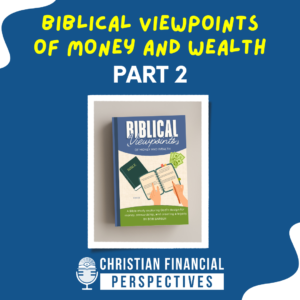
Biblical Viewpoints Of Money And Wealth Part 2
Home » Podcast Episodes » Biblical Viewpoints Of Money And Wealth Part 2

album-art
04/22/2024
00:00
Sorry, no results.
Please try another keyword
  • 4393
    https://www.christianfinancialpodcast.com/198-biblical-viewpoints-of-money-and-wealth-part-2/
    Biblical Viewpoints Of Money And Wealth Part 2
    198
    Do you struggle with aligning your view of money and wealth with the Bible or are you looking for a deeper Biblical perspective? For several episodes, Bob and Shawn are diving into a study examining God's design for wealth and work. In part 2 of 3, they delve into the differences between secular and Biblical counsel, and the Biblical perspective on money and wealth. We recommend you to go back and listen to part 1 before digging deeper into this episode of “Biblical Viewpoints of Money and Wealth”. The book can be found on Amazon, and we encourage listeners to engage in the study and to share the episode with others who may find it beneficial.
    Shawn: Do you struggle with aligning your view of money and wealth with the Bible or are you looking for a deeper Biblical perspective? We’ll dive into a study examining God’s design for wealth and work. Let’s get some perspective. Welcome back to Christian Financial Perspectives. Today we’re going to be covering part two of our Biblical Viewpoints Bible study. I’m going to pass it over to Bob since this is something that he worked a lot on and figured it’d be better let him kind of introduce it, especially for those who may be missed the last episode. Bob: Sure thing, Shawn. So about six years ago I wrote a seven week Bible study called Biblical Viewpoints of Money and Wealth, and last week, this week, and next week, what we’re doing is we’re quickly giving a brief overview of what this Bible study is about. And the nice thing is if you’d like a copy of it, you can go to Amazon and just put in Biblical viewpoints of money and wealth and you can get a copy for yourself. And a lot of people like to teach this in a small group. It’s been taught many times in small groups. This is also a revised edition of Seven Pillars of Biblical Stewardship, which was taught in hundreds of churches 10 years ago, 10, 12 years ago, something like that. Shawn: This is more, a little more, no, no, I wouldn’t say simplified, but I guess you set this one up in a way that someone could pick up the book by themselves and go through it. Or they could pick it up for the first time and go through it with their small group. Seven pillars, just the way that you guys had set it up before, I know there are other people that were part of that process. It was took more, I don’t know how else to say that. Bob: Well… Shawn: They needed to be trained on how to go through it. Bob: They did. They had to be trained on it. So this is a seven week Bible study that really digs deep into what God’s word says about money. And I would emphasize if you didn’t get to hear last week’s program covering what’s being covered in the first three weeks of the study, that you would go back and listen. We encourage that. Either listen to it or view it on YouTube. Shawn: This is a great study. I know I’ve been through it I guess a couple times now because I’ve gone through it once and then we went through it again not that long ago as a staff. Bob: About a year ago. Shawn: And very, very beneficial. It’s very Bible heavy. So there are a lot of different kinds of books that you can go through in a small group setting, and some of them are a page of writing and then there’s a scripture verse kind of a methodology, which there’s nothing wrong with that, but this one is more of here’s a question, read these 2, 3, 4 scriptures, and then maybe there’s a follow-up of, okay, great. So now from what you read, here’s a question, write down what you got from that. And so I really like that personally because it allows the scripture to lead the person who’s going through a study like this. It allows scripture to lead more than just what you as an author or someone else as an author is specifically trying to say. So I think it’s really good. Bob: Yes, it’s truly a Bible study and you’ve got to have your Bible to go through it. Shawn: Or the Bible app. I know a lot of… Bob: Okay. Yeah. So the foundation behind this study is that Biblical wealth comes from, belongs to, and should honor God, as well as that wealth, how it should be distributed to the next generation wisely. Okay. Shawn: The Biblical wealth is here’s a, I guess you’d say a definition, is providing for those God has entrusted to us, supporting the church, spreading the gospel, sending out and supporting missionaries, providing for God’s family, feeding the hungry, clothing the poor, sheltering the homeless, healing the sick, educating the hopeless, protecting the innocent, and providing for widows and orphans. Bob: Straight from scripture. Shawn: That’s right. Bob: These seven viewpoints that we cover over this seven week period are the first week we cover the difference between a Biblical and secular worldview. And that forms the foundation for the rest of the Bible study how to handle wealth from a Biblical perspective. Then week two covers the differences between an owner and a manager. And that’s an interesting one. What does that mean? Well, we’re managers and God is the owner. So we go through the scenario of like a restaurant owner, you own the restaurant, but what if you were the manager of the restaurant? How would those differ? Shawn: How would you act? How would you treat the assets and the things that you have differently if you were a manager versus an owner? And then week three covers the Biblical worldview of work and retirement. So we’re going to be covering, starting today, we’re going to be starting with week four. And then we’re also going to talk a little bit about week five for the Bible study. Week four looks at the difference between secular and Biblical counsel. Week five then covers money and wealth from a Biblical worldview. Bob: And then week six and seven, week six covers giving and blessings from a Biblical worldview. And week seven covers properly leaving an inheritance and legacy for the following generations. Shawn: That’s right. Okay, here we are. We’re going to get into starting with, for today, week four and diving into the differences between secular and Biblical counsel and a few of the scriptures we’re going to look at. We’re going to start first with Proverbs 15:22. Bob, you want to read that one? Bob: Well, I know that one, I don’t even have to read it. That’s one of my favorite scriptures in all the Bible is that, “Plans fail from lack of counsel, but with many advisors they succeed.” Shawn: And then Ecclesiastes 4:9-12, “Two are better than one because they have a good return for their labor. If either of them falls down, one can help the other up, but pity anyone who falls and has one to help them up. Also, if two lie down together, they’ll keep warm. But how can one keep warm alone? Though one may be overpowered, two can defend themselves, and a cord of three strands is not quickly broken.” Bob: So you got the two, and then the third cord is the Holy Spirit giving you that guidance. So there’s 20 characteristics, also, that’s in 1 Timothy 3:1-12. And we are not going to read that entire passage, but this has to do the difference between a Biblical worldview and a secular worldview. And we also look at what 20 characteristics to avoid. So we look for 20 characteristics of what to look for in Biblical counsel and 20 characteristics of what to avoid in secular counsel that is found in 2 Timothy 3:2-5, and 1 Corinthians 6:9-10, and we list all 20 of ’em. So that’s the neat thing about the study. You do that, remember the first week we did that, we did the difference between a Biblical worldview and a secular worldview. So here it’s side by side. You’re looking at this is the characteristics of Biblical counsel and then this is the characteristics of secular counsel and what to avoid. You can see they go right down the page, come right out at you. And by the end of week four in this study, you’re going to truly see the difference between Biblical and secular counsel and how important it is. And you’re going to see the benefits of Biblical counsel and the dangers of secular counsel. Shawn: I think that’s a good chapter. Alright, well we’ll just stop there. I’m just kidding. Okay. Alright. And then week five. So coming off of that, and obviously there’s no requirement, too, if you get this book, especially if you’re going through it by yourself, I mean you could do as many chapters as you want. It’s just typically this is set up more as you do one chapter a week. Bob: Well, you’ll find that it’s going to take you about 30 minutes to do each chapter, 30 to 40 minutes depending on how deep you want to go. And we highly suggest, too, that you pray and ask God’s Holy Spirit to help you interpret scripture in the way that he wants to speak to you. Shawn: That’s right. So in week five, the study covers money and wealth from a Biblical worldview starting with Deuteronomy 8:18, “But remember the Lord your God for it is he who gives you the ability to produce wealth and so confirms his covenant, which he swore to your ancestors as it is today.” Bob: So we look at this word “wealth” because we’re talking about money and wealth from a Biblical worldview. And that wealth appears in scripture over 100x, Shawn, it’s referred to both positively and cautiously. Wealth can be a great thing, but also it can hurt. It can be a blessing and a curse if not handled with wisdom. And we’ve seen that in so many people. I mean, you just look across society and see how wealth has totally destroyed some people, but others who have handled it correctly and done it from a Biblical worldview. It can be a great blessing. Shawn: When you get someone that wins the lottery and all of a sudden they have all this extra money and you would think, oh, it’d solve all their problems. But if anything, it typically makes everything so much worse. Bob: They’re worse off after than before. Now they’re well off for a while, and we call that sudden wealth syndrome and sudden wealth syndrome, we’ve had a program on that because it can come in many different ways, not just through a lottery. Shawn: It could be lottery, could be relative that passes away… Bob: Inheritance. Shawn: Life insurance from a spouse. I mean, who knows? There’s a lot of different ways. Bob: We’ve seen it many different ways. Shawn: Oil and gas. Bob: A lot of oil and gas, especially where we are. We’re within an hour’s drive of one of the biggest oil hits in the world called the Eagle Ford Shell. It’s not the biggest, but it’s very large. Shawn: It’s big. Bob: It’s really large. And I drive down through it on our way down to our place in Rockport, Texas on the coast, and I’m always seeing all these oil wells. Shawn: So that sudden wealth syndrome, it creates a false sense of power and security, or at least it can, that causes a person to make a irrational decisions rejecting any and all wise counsel from others who have experience in handling wealth. Many times what they don’t realize is that that wealth can disappear just as quickly if it is not handled correctly and with wisdom. And I think the most common example of that, Bob, is when someone discovers oil or natural gas or something on their property and all of a sudden, I mean we saw how many times did you see that Eagle Ford Shell? You’d have a household that’s making $40,000-50,000 maybe a year, and all of a sudden they’re making what, a $100,000 a month or more? And it just very quickly then goes down to where now maybe they’re making what, $10,000 a month, maybe? Bob: Exactly. 10-20k. Shawn: If that person isn’t wise with that money coming in and they adjust their lifestyle, assuming they’re going to continue to make a million or more dollars a year, you got a bunch of boats and cars and all these houses and stuff that you can’t maintain anymore once the income starts dropping back down, which inevitably happens in that kind of a situation. Bob: As we look in that week five from Biblical wealth and how to handle that, we use Ecclesiastes 11:2. And that’s a discussion, “Investing in seven ventures, yes, in eight, for you do not know what disaster may come upon the land.” That’s about wealth and how to invest wealth. We take this scripture into the study and we list seven to eight areas. You list it out with your group or by yourself, what did Solomon invest in? And you can go to scripture and you can see it will tell you what Solomon invested in. And then you can look at today, how would you invest? Shawn: I think one of the things that you got to remember too is that when we look at where Solomon invested, it’s not a recommendation that you go buy a bunch of goats and cattle necessarily. I think the wisdom from that is more in the fact that Solomon didn’t just have all one or two or three things, that he had wealth spread across pretty much whatever was available to him. So there are things that are available now. Bob: Shipping, there was transportation, there was actually back then it was gold back then. Shawn: But also there was no fiat currency back then. That’s true. So very different. Bob: That’s true.That is definitely true. And we don’t use gold now when we go to the store and buy something. Shawn: Exactly. Yeah. Bob: We use our debit card. Shawn: We get more into that in the study. We get more into the study. I just wanted to at least mention that. Bob: We also, in this instant, we look at a business owner and three different kinds of managers of a business. I’m going to give you some of these scenarios and it’s kind of fun to think about this. Pretend you’re an owner of a business and you have a manager. The first manager never shows up early or ever offers to stay late and help you with anything, even if there’s a major problem. Shawn: Yeah. Maybe you got inventory that came in and you really got to get it finished before the next day. Well, it’s five o’clock. See you later. Bob: The second manager, so we got manager, that was manager number one. We got the manager number two shows up on time every day, but only does enough to get by. And then you got manager number three. He shows up early every day, stays late if necessary, not every day, but if necessary, offers suggestions for making things better and goes way beyond the call of duty. So of the three managers, which one would you want to give more responsibility to? Shawn: And possibly a raise? Bob: Exactly. And so we ask. Shawn: Oh, definitely number one. Yeah. Haha. Bob: So we use a scriptural guideline in this of Luke 16:10-12, and I would invite you to go look that up because it talks about if you’re good with a little, you can be good with more. Okay. Shawn: Again, it’s never a, it should never be looked at, I feel like, when we’re talking about these kinds of scriptures and principles that you are managing what you have well just because you want more, because then I feel like we kind of miss the whole point. And especially some of these other chapters, you miss the whole point. As believers, as followers of Christ, when we do a good job with what God has blessed us with and entrusted us with, it’s out of respect and reverence and worship for him, not with an expectation of, “Okay, I did a good job. Give me more, please.” Bob: Oh yeah. Shawn: But there is that other aspect of it of if you do well, then it’s kind of like this thing of, okay, the Lord does know that should he give you more, He knows you’re going to do well with it. Bob: You think about the third manager, that third manager that went beyond the call of duty had a humble heart. It wasn’t all about him. It was about helping the business that he was working for. Well, that’s all for today. And don’t forget, if you’ve not heard last week’s program, we’d invite you to go back and listen to that. We’re going to cover this again next week on our three part series of “Biblical Viewpoints of Money and Wealth”. We’re going to cover next week how to handle giving and blessings from a Biblical worldview and how to leave that inheritance for the following generations. All seven weeks of the modules build on each other. Or they could even stand alone, but they build on each other. And our prayer is that God will use this Bible study to renew minds and transform how people view and handle money through this lens. Shawn: That’s right. This Bible study is very focused on the hearts and minds of people. It’s not specific advice of buy this or invest in this particular thing, or this is how you budget. But we really hope that if this study does sound interesting or beneficial to you, please consider purchasing your own copy, either for yourself or for your own study group. And don’t forget to share this episode with others that you think might find it beneficial. It doesn’t cost anything. Bob: And you can find the study where? Shawn: You can find the study – the easiest place honestly, would just be go to Amazon and search for “Biblical viewpoints of money and wealth” and that’s basically it. But feel free to reach out to us with comments, questions by phone or text at (830) 609-6986. God bless. [DISCLOSURES] * Investment advisory services offered through Christian Investment Advisors Inc dba Christian Financial Advisors®, a registered investment advisor registered with the SEC. Registration as an investment advisor does not imply a certain level of skill or training. Comments from today’s show are for informational purposes only and not to be considered investment advice or recommendations to buy or sell any company that may have been mentioned or discussed. The opinions expressed are solely those of the hosts, Bob Barber and Shawn Peters, and their guests. Bob and Shawn do not provide tax advice and encourage you to seek guidance from a tax professional. While Christian Financial Advisors® believes the information to be accurate and reliable, we do not claim or have responsibility for its completeness, accuracy, or reliability.
    https://christianfinancialadvisors.com/podcast/198-biblical-viewpoints-of-money-and-wealth-part-2/
    https://christianfinancialadvisors.com/podcasts/episodes/198-biblical-viewpoints-of-money-and-wealth-part-2/
    937789967

Biblical Viewpoints Of Money And Wealth Part 2

Do you struggle with aligning your view of money and wealth with the Bible or are you looking for a deeper Biblical perspective? For several episodes, Bob and Shawn are diving into a study examining God's design for wealth and work. In part 2 of 3, they delve into the differences between secular and Biblical counsel, and the Biblical perspective on money and wealth.

We recommend you to go back and listen to part 1 before digging deeper into this episode of “Biblical Viewpoints of Money and Wealth”. The book can be found on Amazon, and we encourage listeners to engage in the study and to share the episode with others who may find it beneficial.


Episode Transcript

Shawn:
Do you struggle with aligning your view of money and wealth with the Bible or are you looking for a deeper Biblical perspective? We’ll dive into a study examining God’s design for wealth and work. Let’s get some perspective. Welcome back to Christian Financial Perspectives. Today we’re going to be covering part two of our Biblical Viewpoints Bible study. I’m going to pass it over to Bob since this is something that he worked a lot on and figured it’d be better let him kind of introduce it, especially for those who may be missed the last episode.

Bob:
Sure thing, Shawn. So about six years ago I wrote a seven week Bible study called Biblical Viewpoints of Money and Wealth, and last week, this week, and next week, what we’re doing is we’re quickly giving a brief overview of what this Bible study is about. And the nice thing is if you’d like a copy of it, you can go to Amazon and just put in Biblical viewpoints of money and wealth and you can get a copy for yourself. And a lot of people like to teach this in a small group. It’s been taught many times in small groups. This is also a revised edition of Seven Pillars of Biblical Stewardship, which was taught in hundreds of churches 10 years ago, 10, 12 years ago, something like that.

Shawn:
This is more, a little more, no, no, I wouldn’t say simplified, but I guess you set this one up in a way that someone could pick up the book by themselves and go through it. Or they could pick it up for the first time and go through it with their small group. Seven pillars, just the way that you guys had set it up before, I know there are other people that were part of that process. It was took more, I don’t know how else to say that.

Bob:
Well…

Shawn:
They needed to be trained on how to go through it.

Bob:
They did. They had to be trained on it. So this is a seven week Bible study that really digs deep into what God’s word says about money. And I would emphasize if you didn’t get to hear last week’s program covering what’s being covered in the first three weeks of the study, that you would go back and listen. We encourage that. Either listen to it or view it on YouTube.

Shawn:
This is a great study. I know I’ve been through it I guess a couple times now because I’ve gone through it once and then we went through it again not that long ago as a staff.

Bob:
About a year ago.

Shawn:
And very, very beneficial. It’s very Bible heavy. So there are a lot of different kinds of books that you can go through in a small group setting, and some of them are a page of writing and then there’s a scripture verse kind of a methodology, which there’s nothing wrong with that, but this one is more of here’s a question, read these 2, 3, 4 scriptures, and then maybe there’s a follow-up of, okay, great. So now from what you read, here’s a question, write down what you got from that. And so I really like that personally because it allows the scripture to lead the person who’s going through a study like this. It allows scripture to lead more than just what you as an author or someone else as an author is specifically trying to say. So I think it’s really good.

Bob:
Yes, it’s truly a Bible study and you’ve got to have your Bible to go through it.

Shawn:
Or the Bible app. I know a lot of…

Bob:
Okay. Yeah. So the foundation behind this study is that Biblical wealth comes from, belongs to, and should honor God, as well as that wealth, how it should be distributed to the next generation wisely. Okay.

Shawn:
The Biblical wealth is here’s a, I guess you’d say a definition, is providing for those God has entrusted to us, supporting the church, spreading the gospel, sending out and supporting missionaries, providing for God’s family, feeding the hungry, clothing the poor, sheltering the homeless, healing the sick, educating the hopeless, protecting the innocent, and providing for widows and orphans.

Bob:
Straight from scripture.

Shawn:
That’s right.

Bob:
These seven viewpoints that we cover over this seven week period are the first week we cover the difference between a Biblical and secular worldview. And that forms the foundation for the rest of the Bible study how to handle wealth from a Biblical perspective. Then week two covers the differences between an owner and a manager. And that’s an interesting one. What does that mean? Well, we’re managers and God is the owner. So we go through the scenario of like a restaurant owner, you own the restaurant, but what if you were the manager of the restaurant? How would those differ?

Shawn:
How would you act? How would you treat the assets and the things that you have differently if you were a manager versus an owner? And then week three covers the Biblical worldview of work and retirement. So we’re going to be covering, starting today, we’re going to be starting with week four. And then we’re also going to talk a little bit about week five for the Bible study. Week four looks at the difference between secular and Biblical counsel. Week five then covers money and wealth from a Biblical worldview.

Bob:
And then week six and seven, week six covers giving and blessings from a Biblical worldview. And week seven covers properly leaving an inheritance and legacy for the following generations.

Shawn:
That’s right. Okay, here we are. We’re going to get into starting with, for today, week four and diving into the differences between secular and Biblical counsel and a few of the scriptures we’re going to look at. We’re going to start first with Proverbs 15:22. Bob, you want to read that one?

Bob:
Well, I know that one, I don’t even have to read it. That’s one of my favorite scriptures in all the Bible is that, “Plans fail from lack of counsel, but with many advisors they succeed.”

Shawn:
And then Ecclesiastes 4:9-12, “Two are better than one because they have a good return for their labor. If either of them falls down, one can help the other up, but pity anyone who falls and has one to help them up. Also, if two lie down together, they’ll keep warm. But how can one keep warm alone? Though one may be overpowered, two can defend themselves, and a cord of three strands is not quickly broken.”

Bob:
So you got the two, and then the third cord is the Holy Spirit giving you that guidance. So there’s 20 characteristics, also, that’s in 1 Timothy 3:1-12. And we are not going to read that entire passage, but this has to do the difference between a Biblical worldview and a secular worldview. And we also look at what 20 characteristics to avoid. So we look for 20 characteristics of what to look for in Biblical counsel and 20 characteristics of what to avoid in secular counsel that is found in 2 Timothy 3:2-5, and 1 Corinthians 6:9-10, and we list all 20 of ’em. So that’s the neat thing about the study. You do that, remember the first week we did that, we did the difference between a Biblical worldview and a secular worldview. So here it’s side by side. You’re looking at this is the characteristics of Biblical counsel and then this is the characteristics of secular counsel and what to avoid. You can see they go right down the page, come right out at you. And by the end of week four in this study, you’re going to truly see the difference between Biblical and secular counsel and how important it is. And you’re going to see the benefits of Biblical counsel and the dangers of secular counsel.

Shawn:
I think that’s a good chapter. Alright, well we’ll just stop there. I’m just kidding. Okay. Alright. And then week five. So coming off of that, and obviously there’s no requirement, too, if you get this book, especially if you’re going through it by yourself, I mean you could do as many chapters as you want. It’s just typically this is set up more as you do one chapter a week.

Bob:
Well, you’ll find that it’s going to take you about 30 minutes to do each chapter, 30 to 40 minutes depending on how deep you want to go. And we highly suggest, too, that you pray and ask God’s Holy Spirit to help you interpret scripture in the way that he wants to speak to you.

Shawn:
That’s right. So in week five, the study covers money and wealth from a Biblical worldview starting with Deuteronomy 8:18, “But remember the Lord your God for it is he who gives you the ability to produce wealth and so confirms his covenant, which he swore to your ancestors as it is today.”

Bob:
So we look at this word “wealth” because we’re talking about money and wealth from a Biblical worldview. And that wealth appears in scripture over 100x, Shawn, it’s referred to both positively and cautiously. Wealth can be a great thing, but also it can hurt. It can be a blessing and a curse if not handled with wisdom. And we’ve seen that in so many people. I mean, you just look across society and see how wealth has totally destroyed some people, but others who have handled it correctly and done it from a Biblical worldview. It can be a great blessing.

Shawn:
When you get someone that wins the lottery and all of a sudden they have all this extra money and you would think, oh, it’d solve all their problems. But if anything, it typically makes everything so much worse.

Bob:
They’re worse off after than before. Now they’re well off for a while, and we call that sudden wealth syndrome and sudden wealth syndrome, we’ve had a program on that because it can come in many different ways, not just through a lottery.

Shawn:
It could be lottery, could be relative that passes away…

Bob:
Inheritance.

Shawn:
Life insurance from a spouse. I mean, who knows? There’s a lot of different ways.

Bob:
We’ve seen it many different ways.

Shawn:
Oil and gas.

Bob:
A lot of oil and gas, especially where we are. We’re within an hour’s drive of one of the biggest oil hits in the world called the Eagle Ford Shell. It’s not the biggest, but it’s very large.

Shawn:
It’s big.

Bob:
It’s really large. And I drive down through it on our way down to our place in Rockport, Texas on the coast, and I’m always seeing all these oil wells.

Shawn:
So that sudden wealth syndrome, it creates a false sense of power and security, or at least it can, that causes a person to make a irrational decisions rejecting any and all wise counsel from others who have experience in handling wealth. Many times what they don’t realize is that that wealth can disappear just as quickly if it is not handled correctly and with wisdom. And I think the most common example of that, Bob, is when someone discovers oil or natural gas or something on their property and all of a sudden, I mean we saw how many times did you see that Eagle Ford Shell? You’d have a household that’s making $40,000-50,000 maybe a year, and all of a sudden they’re making what, a $100,000 a month or more? And it just very quickly then goes down to where now maybe they’re making what, $10,000 a month, maybe?

Bob:
Exactly. 10-20k.

Shawn:
If that person isn’t wise with that money coming in and they adjust their lifestyle, assuming they’re going to continue to make a million or more dollars a year, you got a bunch of boats and cars and all these houses and stuff that you can’t maintain anymore once the income starts dropping back down, which inevitably happens in that kind of a situation.

Bob:
As we look in that week five from Biblical wealth and how to handle that, we use Ecclesiastes 11:2. And that’s a discussion, “Investing in seven ventures, yes, in eight, for you do not know what disaster may come upon the land.” That’s about wealth and how to invest wealth. We take this scripture into the study and we list seven to eight areas. You list it out with your group or by yourself, what did Solomon invest in? And you can go to scripture and you can see it will tell you what Solomon invested in. And then you can look at today, how would you invest?

Shawn:
I think one of the things that you got to remember too is that when we look at where Solomon invested, it’s not a recommendation that you go buy a bunch of goats and cattle necessarily. I think the wisdom from that is more in the fact that Solomon didn’t just have all one or two or three things, that he had wealth spread across pretty much whatever was available to him. So there are things that are available now.

Bob:
Shipping, there was transportation, there was actually back then it was gold back then.

Shawn:
But also there was no fiat currency back then. That’s true. So very different.

Bob:
That’s true.That is definitely true. And we don’t use gold now when we go to the store and buy something.

Shawn:
Exactly. Yeah.

Bob:
We use our debit card.

Shawn:
We get more into that in the study. We get more into the study. I just wanted to at least mention that.

Bob:
We also, in this instant, we look at a business owner and three different kinds of managers of a business. I’m going to give you some of these scenarios and it’s kind of fun to think about this. Pretend you’re an owner of a business and you have a manager. The first manager never shows up early or ever offers to stay late and help you with anything, even if there’s a major problem.

Shawn:
Yeah. Maybe you got inventory that came in and you really got to get it finished before the next day. Well, it’s five o’clock. See you later.

Bob:
The second manager, so we got manager, that was manager number one. We got the manager number two shows up on time every day, but only does enough to get by. And then you got manager number three. He shows up early every day, stays late if necessary, not every day, but if necessary, offers suggestions for making things better and goes way beyond the call of duty. So of the three managers, which one would you want to give more responsibility to?

Shawn:
And possibly a raise?

Bob:
Exactly. And so we ask.

Shawn:
Oh, definitely number one. Yeah. Haha.

Bob:
So we use a scriptural guideline in this of Luke 16:10-12, and I would invite you to go look that up because it talks about if you’re good with a little, you can be good with more. Okay.

Shawn:
Again, it’s never a, it should never be looked at, I feel like, when we’re talking about these kinds of scriptures and principles that you are managing what you have well just because you want more, because then I feel like we kind of miss the whole point. And especially some of these other chapters, you miss the whole point. As believers, as followers of Christ, when we do a good job with what God has blessed us with and entrusted us with, it’s out of respect and reverence and worship for him, not with an expectation of, “Okay, I did a good job. Give me more, please.”

Bob:
Oh yeah.

Shawn:
But there is that other aspect of it of if you do well, then it’s kind of like this thing of, okay, the Lord does know that should he give you more, He knows you’re going to do well with it.

Bob:
You think about the third manager, that third manager that went beyond the call of duty had a humble heart. It wasn’t all about him. It was about helping the business that he was working for. Well, that’s all for today. And don’t forget, if you’ve not heard last week’s program, we’d invite you to go back and listen to that. We’re going to cover this again next week on our three part series of “Biblical Viewpoints of Money and Wealth”. We’re going to cover next week how to handle giving and blessings from a Biblical worldview and how to leave that inheritance for the following generations. All seven weeks of the modules build on each other. Or they could even stand alone, but they build on each other. And our prayer is that God will use this Bible study to renew minds and transform how people view and handle money through this lens.

Shawn:
That’s right. This Bible study is very focused on the hearts and minds of people. It’s not specific advice of buy this or invest in this particular thing, or this is how you budget. But we really hope that if this study does sound interesting or beneficial to you, please consider purchasing your own copy, either for yourself or for your own study group. And don’t forget to share this episode with others that you think might find it beneficial. It doesn’t cost anything.

Bob:
And you can find the study where?

Shawn:
You can find the study – the easiest place honestly, would just be go to Amazon and search for “Biblical viewpoints of money and wealth” and that’s basically it. But feel free to reach out to us with comments, questions by phone or text at (830) 609-6986. God bless.

[DISCLOSURES]

* Investment advisory services offered through Christian Investment Advisors Inc dba Christian Financial Advisors®, a registered investment advisor registered with the SEC. Registration as an investment advisor does not imply a certain level of skill or training. Comments from today’s show are for informational purposes only and not to be considered investment advice or recommendations to buy or sell any company that may have been mentioned or discussed. The opinions expressed are solely those of the hosts, Bob Barber and Shawn Peters, and their guests. Bob and Shawn do not provide tax advice and encourage you to seek guidance from a tax professional. While Christian Financial Advisors® believes the information to be accurate and reliable, we do not claim or have responsibility for its completeness, accuracy, or reliability.

[DISCLOSURES]

Investment advisory services offered through Christian Investment Advisors Inc dba Christian Financial Advisors®, a registered investment advisor registered with the SEC. Registration as an investment advisor does not imply a certain level of skill or training. Comments from today’s show are for informational purposes only and not to be considered investment advice or recommendations to buy or sell any company that may have been mentioned or discussed. The opinions expressed are solely those of the hosts, Bob Barber and Shawn Peters, and their guests. Bob and Shawn do not provide tax advice and encourage you to seek guidance from a tax professional. While Christian Financial Advisors® believes the information to be accurate and reliable, we do not claim or have responsibility for its completeness, accuracy, or reliability.

Recent Episodes

  • A Biblical Worldview of Tithing and Giving
  • A Biblical Worldview of Money and Wealth
  • Donor Advised Funds: Give More, Save More
  • Year End Tax Strategies for 2025
  • The Basic 4 Uses of Money

Episode Archive

About Our Firm

Christian Financial Advisors serves clients nationwide with our headquarters in New Braunfels, Texas, located between Austin and San Antonio. Our focus is guiding you toward your financial goals by integrating Christian-based advice into financial planning, retirement planning and investment management.

LEARN MORE

  • About Us
  • What We Believe
  • Services
  • Fees & Service Tiers
  • Investment Services
  • Contact

Schedule A Meeting

Schedule an appointment right from your phone or computer with our online calendar tool.

SCHEDULE A MEETING

Keep In Touch

© Copyright 2026 Christian Investment Advisors Inc. All Rights Reserved. View our Privacy Policy.
Investment advisory services offered through Christian Investment Advisors Inc dba Christian Financial Advisors® (herein referred to as “Advisor”), a Registered Investment Advisor registered with the SEC. Registration as an investment adviser does not imply a certain level of skill or training.
Advisor and its representatives are in compliance with the current filing requirements imposed upon registered investment advisors by those jurisdictions in which Advisor maintains clients. Advisor may only transact business in those states where it is registered or qualifies for an exemption or exclusion from registration requirements. Advisor’s website is limited to disseminating general information about its advisory services and access to additional investment-related information, publications, and links. Accordingly, the publication of Advisor’s website on the Internet should not be construed by any consumer and/or prospective client as Advisor’s solicitation to effect or attempt to effect transactions in securities, or the rendering of personalized investment advice for compensation, over the Internet. Any subsequent, direct communication by Advisor with a prospective client shall be conducted by a representative that is either registered or qualifies for an exemption or exclusion from registration in the state where the prospective client resides. For information about the registration status of Advisor, please contact the SEC, FINRA, or the state securities regulators for those states in which Advisor maintains a filing.
A copy of Advisor’s current written disclosure statement discussing Advisor’s business operations, services, and fees is available from Advisor upon written request. Advisor does not make any representations or warranties regarding the accuracy, timeliness, suitability, completeness, or relevance of any information prepared by any unaffiliated third party, whether linked to Advisor’s website or incorporated herein and takes no responsibility, therefore. All such information is provided solely for convenience purposes only, and all users thereof should be guided accordingly.
Past performance may not be indicative of future results. Therefore, no current or prospective client should assume that the future performance of any specific investment or investment strategy (Including the investments and/or investment strategies recommended or undertaken by Advisor) made reference to directly or indirectly by Advisor on its website or indirectly by a link to an unaffiliated third party website, will be profitable or equal the corresponding indicated performance level(s). Different types of investments involve varying degrees of risk, and there can be no assurance that any specific investment will either be suitable or profitable for a client or prospective client’s investment portfolio.
Certain portions of Advisor’s website (i.e. newsletters, articles, commentaries, etc.) may contain a discussion of, and/or provide access to, Advisor’s (and those of other investment and non-investment professionals) positions and/or recommendations of a specific prior date. Due to various factors, including changing market conditions, such discussion may no longer be reflective of current position(s) and/or recommendations(s). Moreover, no client or prospective client should assume that any such discussion serves as the receipt of, or a substitute for, personalized advice from Advisor or any other investment professional. Advisor is neither an attorney nor an accountant, and no portion of the website content should be interpreted as legal, accounting, or tax advice.
To the extent that any client or prospective client utilizes any economic calculator or similar device contained within or linked to Advisor’s website, the client and/or prospective client acknowledges and understands that the information resulting from the use of any such calculator/device, is not, and should not be construed, in any manner whatsoever, as the receipt of, or a substitute for, personalized individual advice from Advisor, or any other investment professional.
Advisor may provide links from this Site to a non- Advisor Website or permit a link from a non- Advisor Website to this Site. Such links are for your convenience only and do not imply any affiliation with or an endorsement, authorization, sponsorship, or promotion of the non- Advisor website or its owner. Advisor does not control or review any link and accepts no responsibility for the content, products, or services provided at these linked websites. If you decide to access such non- Advisor Websites, you do so solely at your own risk, and you should be aware that non- Advisor websites are governed by their own terms and conditions and privacy policies. Links to this site may be made only with the permission of Advisor. A link to this Site may be permitted at Advisor’s discretion, where, without limitation, such link (a) is to this site’s homepage, (b) clearly informs users that the link is to the Advisor’s Website, (c) does not imply any affiliation, endorsement, sponsorship or other relationship between the link Advisor Website or the Website owner and Advisor, (d) delivers this site’s Content without framing, or similar environment, and (e) maintains the integrity of this site’s layout, content and look and feel. Advisor reserves the right in its sole discretion to refuse permission or to cancel permission to link to this site at any time.
Certified Financial Planner Board of Standards Center for Financial Planning, Inc. owns and licenses the certification marks CFP®, CERTIFIED FINANCIAL PLANNER™, and CFP® (with plaque design) in the United States to Certified Financial Planner Board of Standards, Inc., which authorizes individuals who successfully complete the organization’s initial and ongoing certification requirements to use the certification marks.
  • About
      • Our Team
      • What We Believe
          • Our Guiding Principles
          • Our Investment Principles
        • Close Menu
      • How We Are Paid
      • How We Are Different
      • Values Based Investing
      • CIS Wealth?
    • Close Menu
  • Services
      • Fees and Service Tiers
      • Investment Management
      • Financial Planning
      • Retirement Planning
      • Estate Planning
      • Planned Giving
      • Trust Services
    • Close Menu
  • Education
      • All Articles
      • Monthly Bullet Points
      • Monthly Financial Newsletter
      • Podcast
      • What The Bible Says About Finance
    • Close Menu
  • Locations
      • New Braunfels, Texas
      • Land O’ Lakes, Florida
    • Close Menu
  • Client Logins
  • Schedule a Meeting
Schedule a Meeting
{{playListTitle}}
  • {{ index + 1 }}
    {{ track.track_title }} {{ track.track_artist }} {{ track.album_title }} {{ track.length }}
artwork-hover Player Audio Artwork
{{list.tracks[currentTrack].track_title}}{{list.tracks[currentTrack].track_artist && typeof sonaar_music.option.show_artist_name != 'undefined' ? ' ' + sonaar_music.option.artist_separator + ' ' + list.tracks[currentTrack].track_artist:''}}
{{list.tracks[currentTrack].album_title}}
{{ list.tracks[currentTrack].album_title }}
Player Audio Artwork
{{list.tracks[currentTrack].track_title}}
{{list.tracks[currentTrack].track_artist }}
{{classes.speedRate}}X
Player Audio Artwork
{{list.tracks[currentTrack].track_title}}
{{list.tracks[currentTrack].track_artist }}
{{ cta['store-name'] }}