

May 2025 – Christian Stewardship and Investing
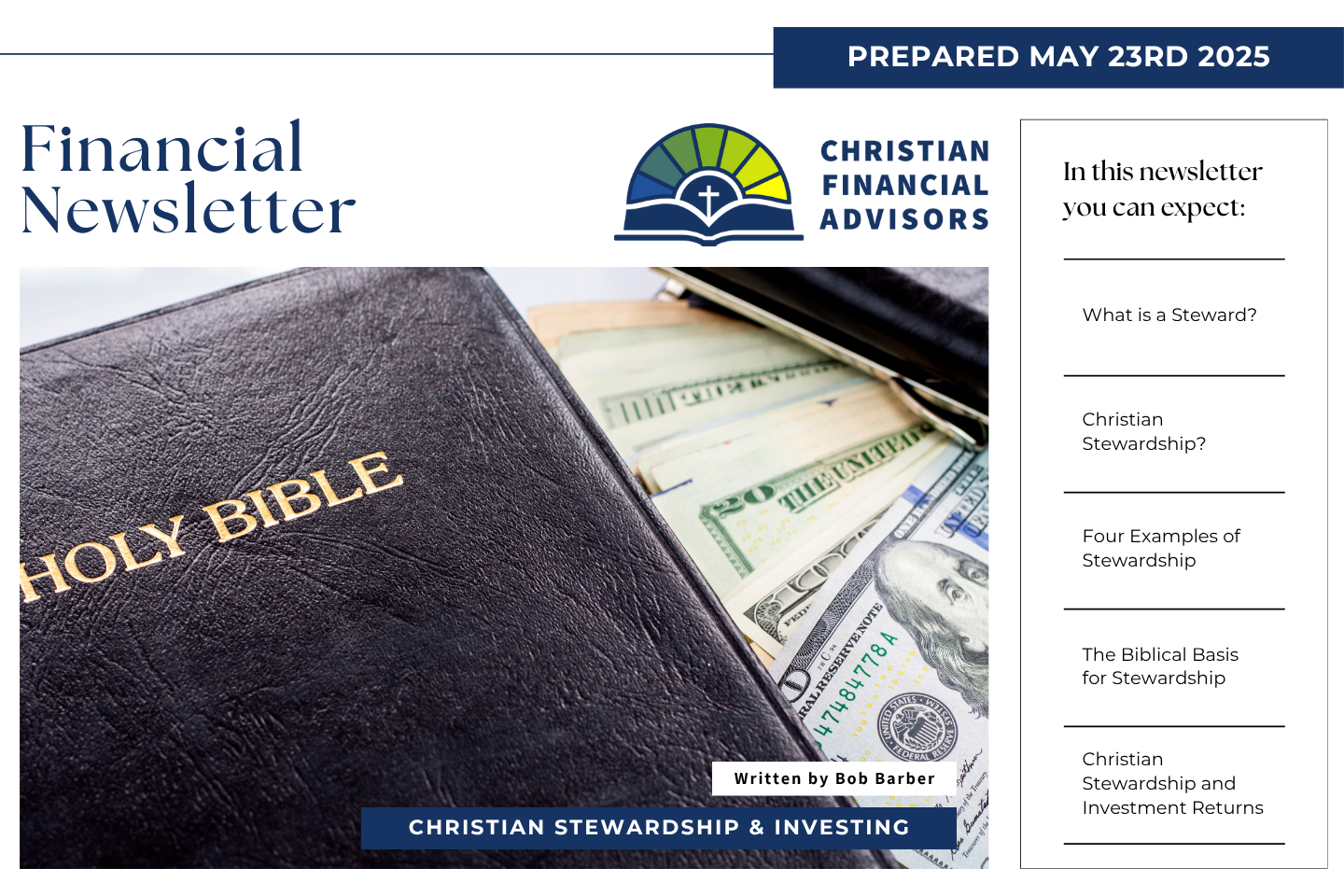
written by Bob Barber
What is a Steward? The definition
A steward is responsible for managing anything entrusted to their care. This includes managing property, resources, finances, planning, organizing, staffing, leading, and making wise decisions.
Christian Stewardship?
Christian stewardship is the understanding that God owns everything and that we are managers of His creation and resources. It is the belief that everything we have, including our time, talents, resources, finances, investments, possessions, and relationships, is a gift from God to be used responsibly and for His glory rather than only for personal gain, knowing we will be accountable for how we use them.
Four Examples of Stewardship:
- Stewardship of Finances: Using money wisely, giving generously, and investing with biblical principles.
- Stewardship of Time: Prioritizing God’s work and using time effectively to serve others and advance His kingdom.
- Stewardship of Talent: Using our abilities and skills to serve God and others.
- Stewardship of the Environment: Caring for the earth and its resources, recognizing that we are responsible for protecting God’s creation.
The Biblical Basis for Stewardship:
Stewardship is rooted in many biblical teachings, such as the command to “work the land” (Genesis 2:15) and the parable of the talents (Matthew 25:14-30).
Christian Stewardship and Investing, known as Biblically Responsible Investing
One form of Christian Stewardship is in how we invest God’s resources. Examples include investing in companies that demonstrate Christian values while avoiding companies that support services or produce goods that violate them, regardless of how good the investment returns may or may not be with Biblically Responsible Investing.
Hundreds of scriptures find the Biblical basis for Biblically Responsible Investing and Stewardship. A few of them are:
The earth is the Lord’s, and everything in it, the world, and all who live in it
‘The silver is mine and the gold is mine,’ declares the Lord Almighty.
If anyone, then, knows the good they ought to do and doesn’t do it, it is sin for them.
Therefore, “Come out from them and be separate, says the Lord. Touch no unclean thing, and I will receive you.
Christian Stewardship and Investment Returns
Whoever loves money never has enough; whoever loves wealth is never satisfied with their income. This too is meaningless.
Christian Stewards need to be extremely careful about investment returns becoming idols. In the biblical context, idolatry is giving divine honor or reverence to anything other than God and following biblical guidelines. If we obsess over investment returns or a lack thereof and become fearful, Investment returns can quickly become idols.
For God hath not given us the spirit of fear; but of power, and of love, and of a sound mind.
“You shall have no other gods before me.
For of this you can be sure: No immoral, impure or greedy person—such a person is an idolater—has any inheritance in the kingdom of Christ and of God.
God cares much more about how we invest and our hearts than the returns we make on this earth, whether good, bad, or average. Investments should be viewed as tools for stewarding God’s resources, not as objects of worship.
For the love of money is a root of all kinds of evil. Some people, eager for money, have wandered from the faith and pierced themselves with many griefs.
In this passage, the “love of money” can easily be replaced with the “love of investment returns” because it creates more money.
The question is always, “How much is enough? Is it 7% over 6%, or how about 8%? At what point might we ‘sell out’ our Christian values for possibly a better return if available? Not that it has to be this way with Biblically Responsible Investing.
Keep your lives free from the love of money and be content with what you have, because God has said, “Never will I leave you; never will I forsake you.
Again, replace “love of money” with “love of returns,” as it is the same thing.
Matthew 6:19-21 reminds us about where to store our treasure and why. In verse 21, it states: For where your treasure is, there your heart will be also.
Obsessing over investment returns reflects a materialistic, secular worldview that aligns with the world’s priorities, not God’s. Matthew 6:24 warns, “No one can serve two masters… You cannot serve both God and money.” Pursuing wealth above all else leads us to neglect God’s Kingdom and justice.
Pursuing better investment returns over proper stewardship of God’s resources can cause us to forget that the eternal value of our lives is not found in wealth but in the Kingdom of God. Matthew 6:19-21 teaches that we should store up treasures in heaven, not on earth, where they are temporary.
Christian stewardship and Biblically Responsible investing are very different from the world’s ways.
It’s a clear choice: God’s ways or man’s?
Biblically Responsible Investing is a Christian Steward’s way of aligning their finances with a Biblical Worldview.
The views expressed represent the opinion of Christian Financial Advisors®. The views are subject to change and are not intended as a forecast or guarantee of future results. This material is for informational purposes only. It does not constitute investment advice and is not intended as an endorsement of any specific investment. Stated information is derived from proprietary and nonproprietary sources that have not been independently verified for accuracy or completeness. While Christian Financial Advisors® believes the information to be accurate and reliable, we do not claim or have responsibility for its completeness, accuracy, or reliability. Accordingly, such statements are inherently speculative as they are based on assumptions that may involve known and unknown risks and uncertainties. Actual results, performance or events may differ materially from those expressed or implied in such statements. Past performance is not indicative of future results. For any discussion of equity securities: Investing in equity securities involves risks, including the potential loss of principal. While equities may offer the potential for greater long-term growth than most debt securities, they generally have higher volatility. For any discussion of taxes: Christian Financial Advisors® does not provide tax advice and encourages you to seek guidance from a tax professional.