

10 Rules For Looking At Account Statements and Values During These Chaotic Times

1. Account statement values reflect only current share values. If the share value is down, it does not mean your account has a realized loss. You still own the same amount of shares which will normally gain value again as the markets go back up. You only realize losses if you sell during a down period.
2. It is normal for account values to fluctuate dramatically from day to day and month to month, especially during a down market. Volatility is something you have to endure if you want to participate in significant gains.
3. Bull (up) markets and bear (down) markets are normal and are part of the investing process.
4. Today’s markets are moving up or down as much as 5-10% in just one day. Missing just 10-20 days when markets rebound can cut returns in half over the long run. The chart below illustrates this:
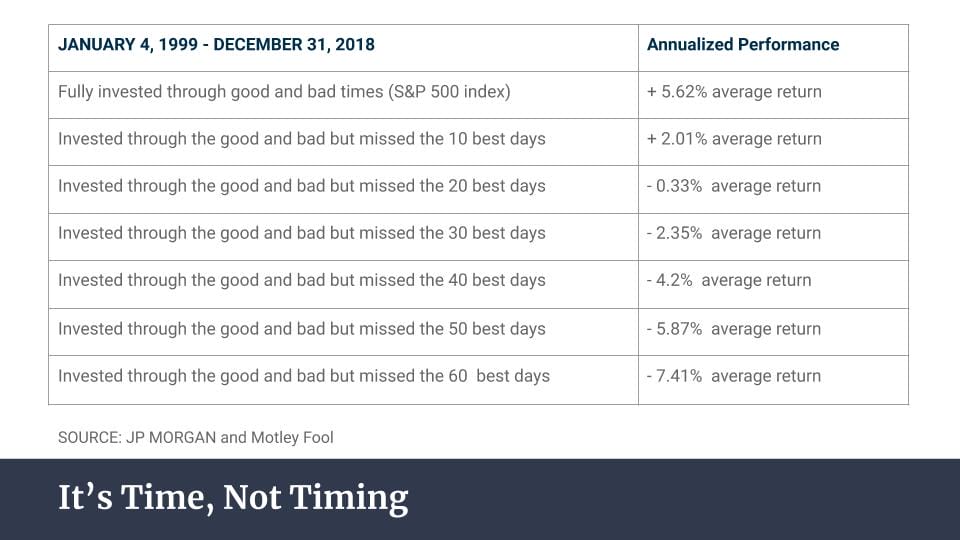
5. It’s human nature to only want to be in the markets when they are going up, and get out when they are declining, but timing the markets has never been proven to work in the long term. It’s time in the markets, not timing the markets that matters the most.
6. What happens over days, weeks, and even a few months should not interfere with a long term, well thought-out, sound investment strategy.
7. When stocks are on sale, it’s a good time to buy more of them, not sell them. For some reason, people love to buy everything on sale except stocks. They love to buy stocks when they are at all time highs which is just the opposite of what you should do.
8. Bear markets cause people to panic, believing it’s always different this time and that the markets will never come back. So, those who panic sell to those who know it’s NOT different this time, and the markets will come back someday. After bear markets, the markets have always historically gone on to new highs.
9. Control your Fight-or-Flight response when it comes to investing. In response to acute stress, the body’s sympathetic nervous system is activated due to the sudden release of hormones that tell us to get away from anything that might hurt us quickly. This is the exact opposite of what someone should do in a well thought out diversified investment strategy.
10. There will always be good and bad times. It’s a normal part of life’s process. Read Ecclesiastes 3:1-8 that we’ve included below.ECCLESIASTES 3:1-8 (NIV)
There is a time for everything, and a season for every activity under the heavens: a time to be born and a time to die, a time to plant and a time to uproot, a time to kill and a time to heal, a time to tear down and a time to build, a time to weep and a time to laugh, a time to mourn and a time to dance, a time to scatter stones and a time to gather them, a time to embrace and a time to refrain from embracing, a time to search and a time to give up, a time to keep and a time to throw away, a time to tear and a time to mend, a time to be silent and a time to speak, a time to love and a time to hate, a time for war and a time for peace.
The views expressed represent the opinion of Christian Financial Advisors®. The views are subject to change and are not intended as a forecast or guarantee of future results. This material is for informational purposes only. It does not constitute investment advice and is not intended as an endorsement of any specific investment. Stated information is derived from proprietary and nonproprietary sources that have not been independently verified for accuracy or completeness. While Christian Financial Advisors® believes the information to be accurate and reliable, we do not claim or have responsibility for its completeness, accuracy, or reliability. Accordingly, such statements are inherently speculative as they are based on assumptions that may involve known and unknown risks and uncertainties. Actual results, performance or events may differ materially from those expressed or implied in such statements. Past performance is not indicative of future results. For any discussion of equity securities: Investing in equity securities involves risks, including the potential loss of principal. While equities may offer the potential for greater long-term growth than most debt securities, they generally have higher volatility. For any discussion of taxes: Christian Financial Advisors® does not provide tax advice and encourages you to seek guidance from a tax professional.